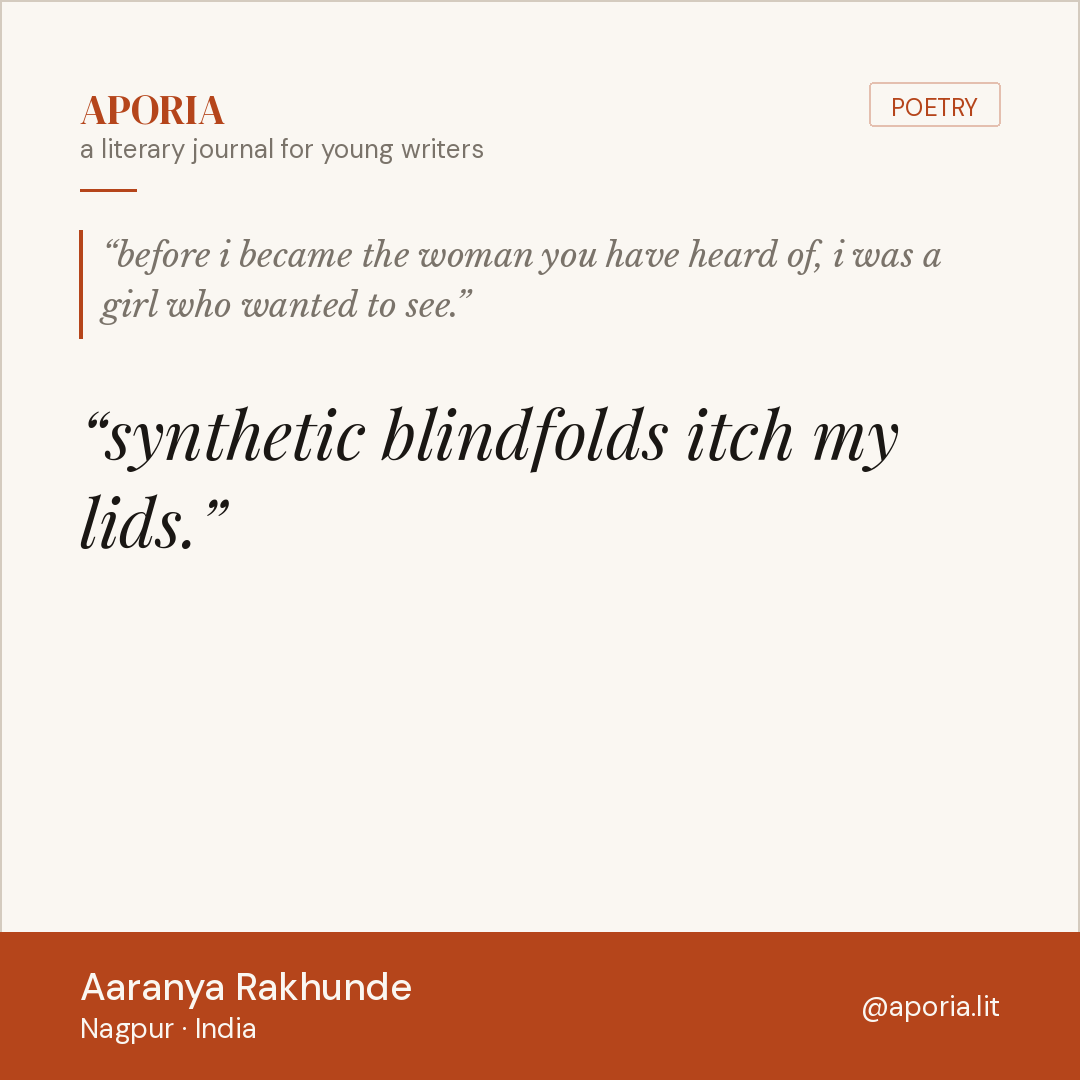
synthetic blindfolds itch my lids.
the first one did too.
before i became gandhari,
before they put the word queen
after my name,
i was a girl who hated
having oil rubbed into her hair.
my mother would sit behind me
with the brass bowl warm
between her knees,
part my hair with her fingers
and tell me to keep still.
i never did.
i would wriggle away,
complain that the oil smelled too strong,
ask whether the jasmine outside
had opened yet.
she would sigh.
i would laugh.
sometimes she caught me
before i could run,
and held my chin in one hand
while she smoothed the oil
into my scalp.
i hated her a little
for answering.
there were mangoes in our courtyard.
the green ones were hard
enough to make the teeth ache.
we stole them before they ripened,
salted them when no one was looking,
hid the pieces in our sleeves.
i was good at stealing things.
not important things.
mangoes.
jaggery.
my brother's wooden horse.
once, i climbed the low wall
just to see what was beyond it
and tore my skirt on a nail.
my mother saw the blood
before she saw the tear.
she shouted.
i laughed again.
i was seventeen.
they told me i was to be married.
the man was a prince.
the kingdom was large.
the family was old.
then someone told me
he was blind.
they did not ask me.
they told me.
at the wedding,
someone kept refilling my cup.
someone kept telling me to smile.
someone said i was lucky.
someone else laughed
and said queens did not need
to worry about such little things.
my earrings hurt.
the garland was too heavy.
the sandalwood paste
had begun to dry
at the edges of my wrists.
i thought about the jasmine
in my mother's courtyard.
i wondered if it had opened.
my husband would never know
what i looked like that night.
i remember the mirror.
someone had polished it
until the lamps trembled
inside the glass.
i looked at myself
for a long time.
my mouth.
my hair.
the little scar on my chin.
i wanted his eyes.
i wanted them to move over my face
and stop somewhere.
i was ashamed of wanting this.
the cloth was on the table.
white.
ordinary.
not silk.
not sacred.
synthetic, perhaps.
i tied it badly.
the knot rubbed
the back of my ear
all morning.
no one noticed.
everyone noticed the gesture.
it was not for love.
not at first.
i wanted one thing
that had not been decided for me.
if he could not see me,
then neither would they.
the palace was strange
when you could not see it.
i learned it by sound.
the courtyard where pigeons
always fought over grain.
the long corridor
where stone made footsteps
sound farther away.
the kitchen by the smell
of cardamom and smoke.
the women by their anklets.
the guards by the rhythm
of their spears against the floor.
i learned which doors complained
when they opened.
which servants dragged one foot.
which lamps hissed
when the oil was low.
my husband and i
learned each other this way.
i knew him first
by the sound of his breathing.
when he was angry,
it became shallow.
when he was tired,
he slept with one hand
curled against his chest.
sometimes he was gentle.
sometimes he was not.
sometimes i loved him.
sometimes i wished
he had been a different man.
at night,
when he could not sleep,
he would ask whether it was raining.
sometimes it was.
sometimes it was not.
sometimes i lied.
i wanted him to imagine
the same rain i was imagining.
once, he burned his fingers
on a dish brought too hot
from the kitchen.
he cursed.
i laughed.
he laughed too.
for a little while
we were simply two people
in a room.
years passed.
people began asking
when i would give them
a child.
soon, they said.
soon.
soon.
soon.
women touched my stomach
when they thought i was not looking.
they pressed their palms there
as though knocking on a door.
i began keeping my hands
over my stomach
just to stop theirs.
there were herbs.
prayers.
oil rubbed into my skin.
women whispering
that this one would surely work.
i was tired.
i was tired of smiling
when they asked.
tired of the word soon.
when it finally happened,
i did not know
what to call what had come.
there was no relief.
only waiting.
i will not tell you
what the women did.
you know the story.
they took what had come
and kept it alive
in a hundred jars.
they waited.
one hundred.
one daughter.
one hundred sons.
one daughter.
they called them a hundred.
i knew them by their hands.
by the way they cried.
by the different weights
of their footsteps
in the corridor.
duryodhana was born first.
before he was a prince,
before he was a rival,
before men put his name
inside their prayers and curses,
he was a boy.
he had sticky hands.
he hated being washed.
he would bite my finger
when he was small.
once,
he fell asleep against my shoulder
with mango juice drying
on his cheek.
i wiped it away
with the edge of my sari.
he woke up angry.
he did not know
why i was laughing.
people speak of him now
as though he arrived
already carrying a crown
and a knife.
he did not.
he was a boy.
he was afraid of thunder.
he hated milk.
once he cried
because his favourite wooden horse
had lost a wheel.
i remember that.
later,
when he learned to lie,
i knew.
his footsteps changed.
his breathing changed.
the pause before he answered
became too long.
sometimes i was proud of him.
sometimes i was ashamed.
sometimes i wanted to shake him
until the boy came back.
sometimes i hated what he became.
sometimes i still knew
the exact place between his eyebrows
where he used to sweat
when he lied.
i chose the blindfold.
i regretted it.
i wore it proudly.
i scratched at it
when it irritated my skin.
there were days
i forgot it was there.
then there were days
i could feel every thread.
the palace grew around me.
my sons grew taller.
their voices deepened.
their footsteps
became harder to tell apart.
then easier.
war came slowly.
first horses.
then men arriving before dawn.
then doors opening
too carefully.
i learned to recognise grief
by the way people entered a room.
some came quickly.
some stopped outside.
some said my name
before they came in.
some did not.
there were footsteps
i waited for
that never returned.
there were cups poured
for people who would not drink them.
there were rooms
that became quiet
without anyone saying why.
one afternoon,
someone left a sword
against the wall
outside my room.
i heard it fall.
no one came back for it.
my husband breathed beside me.
one.
two.
three.
four.
then stopped.
after the war,
people spoke to me
in softer voices.
they called me mother.
queen.
widow.
the mother of a hundred sons.
they said my grief
was enormous.
they said i had suffered greatly.
they said i had been devoted.
they said i had been blind.
they liked that word.
blind.
sometimes i touch the knot.
the old one was rough.
the new ones are synthetic.
they all itch.
sometimes i loosen it.
sometimes i leave it alone.
i still remember
the smell of jasmine.
i still remember
green mangoes
cut before they were ready.
i still remember
my mother's fingers
parting my hair.
sometimes i try to remember
the exact pressure of them.
i remember the brass bowl.
the smell.
her voice telling me
to keep still.
not the pressure.
that frightens me.
i still remember
my husband's breathing
in the dark.
i still remember
mango juice
drying on my son's cheek.
the stories will go on without me.
they always have.
they will tell you
why i tied it.
they will tell you
what it meant.
they will tell you
whether i was good.
let them.
before i became
the woman you have heard of,
i was a girl
who wanted to see.
the blindfold
still itches my lids.